Course Information
WRIT 100. Gender and Genre: The Romantic Comedy from Jane Austen to Trainwreck
What makes a good romantic comedy? What do we expect from the genre of romantic comedy, and how have films and novels met (and sometimes upended) those conventions? And what can the romantic comedy tell us about love, marriage, gender roles, and even feminism? This class examines the romantic comedy, beginning with Jane Austen’s Pride and Prejudice and ending with boundary-pushing rom-coms like Bridesmaids and Amy Schumer’s 2015 Trainwreck. Along the way, we consider classic screwball comedies and chick-lit, as well as theories of film and gender that help us make sense of a popular and much-maligned genre.
Course Information
Winter 2017
MWF 2:30-3:25
Newcomb 310
Instructor Information
Washington 108
bufkins@wlu.edu
M and W 9:00-10:00
Tu 1:00-3:00
And by appointment
Course Objectives
This term you will
- Read carefully and critically and respond to that reading systematically and analytically
- Practice developing analytic claims and supporting those claims with specific, appropriate and properly cited evidence
- Reflect on and hone your writing process, with particular attention to revision
- Integrate digitally driven research goals, methods and media with discipline-specific inquiry
- Use design critically
- Assess information and information technologies critically
WRIT 100 Learning Outcomes
Students in WRIT 100 will
- learn rhetorical conventions governing appropriateness and persuasiveness in writing;
- learn the conventions of standard English;
- learn to choose words more precisely, to write clear sentences and effective paragraphs;
- argue a workable thesis;
- integrate the work of others into their own work through proper citation techniques; and
- increase their confidence with written language.
Required Texts
- Austen, Jane. Pride and Prejudice. 4th edition. New York: Norton, 2016.
- Bridesmaids. Directed by Paul Feig, Universal Pictures, 2011.
- Bullock, Richard, Michal Brody and Francine Weinberg. The Little Seagull Handbook. 2nd edition. New York: Norton, 2014.
- Gocsik, Karen, Richard Barsam and David Monahan. Writing About Movies. 4th edition. New York: Norton, 2015.
- Graff, Gerald and Cathy Birkenstein. They Say/I Say: The Moves that Matter in Academic Writing. 3rd edition. New York: Norton, 2014.
- It Happened One Night. Directed by Frank Capra, Columbia Pictures, 1934.
- Jen, Gish. Mona in the Promised Land. New York: Vintage, 1997.
- The Philadelphia Story. Directed by George Cukor, MGM, 1940.
- Trainwreck. Directed by Judd Apatow, Apatow Productions, 2015.
- Course reader
The books and course reader are all available at the Washington and Lee University Store. The films are on reserve at Leyburn Library, and may also be purchased or rented via Amazon, iTunes, or other online services.
Grading
Grading scale
90-92 points A-
87-98 points B+
83-86 points B
80-82 points B-
77-79 points C+
70-72 points C-
67-69 points D+
63-66 points D
60-62 points D-
0-59 points F
Assignments
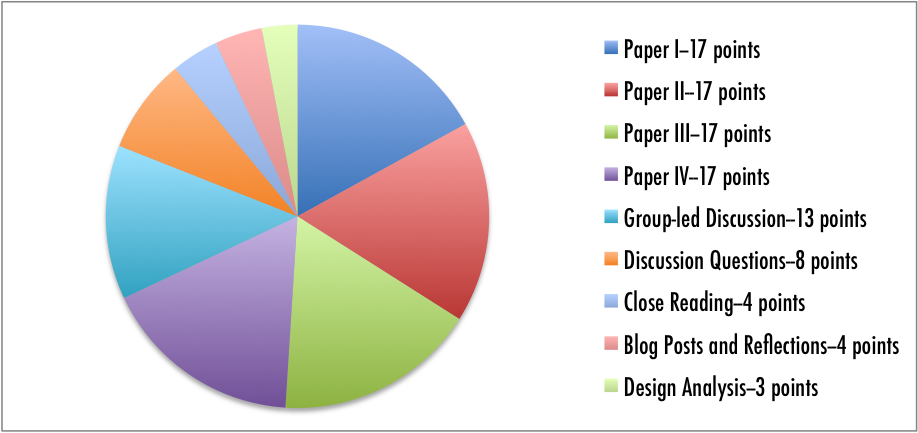
Major Papers
You will write four major papers over the course of the term. Each paper will ask you to develop an analytic argument about the texts we read in the course and to support that argument with specific and concrete evidence drawn from those texts. Prior to submitting each paper for a grade, you will share a draft with your classmates for rigorous and thoughtful peer review. You will also have the opportunity to revise each of your major papers.
Group-led Discussion
During the final unit of the course, you and several of your classmates will select texts for the class to read and discuss in one of our class meetings. In addition to choosing the texts for the day, you and your group will also present the class with discussion questions and facilitate the group in our discussion. You will also submit a written evaluation that reflects on the texts you selected and the success of the group discussion.
Discussion Questions
Nine times during the term, you will be responsible for posting a discussion question about the reading or viewing for the day. I will publish the discussion question schedule at the beginning of the term. Your questions will be worth one point each and will be graded on a check plus/check/check minus scale. I will average the top eight of your nine questions.
Short Assignments
- Early in the term, you will write a short, focused close reading that looks closely at a single scene from Pride and Prejudice. You will then expand on this close reading for your first major paper.
- In preparation for the final paper, you will write a short design analysis examining a website that you want to serve as a design model for your final assignment.
- At several points throughout the term, I will ask you to reflect on and write about your progress in the course. These reflections are intended to help you think about the readings in relation to one another and to help you evaluate your writing process and progress.
Course Policies
Revision
Because revision is an essential part of the writing process, you will have the opportunity to continue to revise each formal writing assignment throughout the term. Each revision should constitute a significant change from the previous draft; revisions that do not contain significant changes will not be accepted.
Class Blog
The blog for this course will serve as a place to extend and expand on our discussions in class. You will post your discussion questions to the blog, and you are encouraged to comment on your classmates’ questions. You will also post the materials for your group-led discussion to the blog, as well as your Paper IV assignment. I will provide instructions for posting to the blog, but if you are having any difficulties, you are responsible for getting assistance, either from me or from campus ITS.
Attendance
Much of the work of this class will be accomplished in discussion, which means your attendance and participation are essential. You may have one no-questions-asked absence during the term; after that, any absences must be explained and, in some cases, documented. Excessive absences will negatively affect your grade, and more than six absences (two full weeks of class) will result in a failing grade for the course.
Technology
Classroom engagement and active discussion are essential parts of this course. For that reason, I ask that you consider carefully your use of technology and whether it serves as a distraction from your participation and attention to your classmates. If using a laptop or tablet is a marked aid to your note-taking process, then you may do so, but I encourage you to put electronic devices away whenever possible. In addition, there should be no audio or visual recording of the class without my explicit permission and that of your classmates.
Plagiarism
Washington and Lee defines plagiarism as “the use of another’s words or ideas without proper acknowledgment.” You are responsible for familiarizing yourself with what constitutes plagiarism and how to avoid it. For assistance, see the resources available on the library website and in The Little Seagull Handbook, and consult with me during my office hours.
Accommodations for Students With Disabilities
Washington and Lee University makes reasonable academic accommodations for qualified students with disabilities. All undergraduate accommodations must be approved through the Office of the Dean of the College. Students requesting accommodations for this course should present an official accommodation letter within the first two weeks of the (fall or winter) term and schedule a meeting outside of class time to discuss accommodations. It is the student’s responsibility to present this paperwork in a timely fashion and to follow up about accommodation arrangements. Accommodations for test-taking should be arranged with the professor at least a week before the date of the test or exam. For more information contact: Lauren Kozak, Assistant Director of Career Development and Title IX Coordinator, Elrod Commons 307, (540) 458-4055.